Engineered Wood vs Veneer vs Solid Wood Furniture
If you have ever shopped for a dining table or credenza, you have probably noticed that "solid wood" gets used as a badge of honor. And for good reason. But the conversation around solid wood vs. engineered wood furniture rarely goes deep enough to help you make a confident decision. What exactly qualifies as solid wood? When does engineered wood actually make sense? And where does veneer fit in? Understanding what is inside your furniture is the best way to spend wisely and live with pieces you will love for decades.
What Solid Wood Means

When furniture is made from solid wood, every structural and visible part is cut from continuous planks of real timber. There is no composite core, no particle filling, and no thin decorative layer glued over something else. The wood you see on the surface is the same wood that runs all the way through.
The species matters. Oak is prized for its tight grain and the way it mellows to a warm honey tone over the years. Walnut brings richness through its deep, chocolatey color and flowing grain. Teak, with its natural oils, handles moisture and temperature swings better than almost any other hardwood, making it the standard for outdoor furniture.
The greatest advantage of solid wood is longevity. A well-built dining table can serve a family for generations. When scratches or water rings appear, the surface can be sanded and refinished, something you simply cannot do with engineered or veneered surfaces. Solid wood does expand and contract with humidity, so quality construction must account for seasonal movement. It is heavier and more expensive than the alternatives. But for pieces you plan to keep, the investment compounds rather than diminishes over time.
Engineered Wood

Engineered wood includes MDF (medium-density fiberboard), plywood, and particleboard, all manufactured by binding wood fibers, particles, or thin layers with adhesives under heat and pressure. The result is a stable, uniform material that resists the seasonal movement of natural wood.
MDF has a perfectly smooth surface that takes paint beautifully, making it a strong choice for lacquered cabinet doors and built-in shelving. Plywood, built from layers glued with alternating grain directions, offers impressive structural strength and warp resistance. Both have legitimate roles in furniture construction, particularly for interior panels, drawer bottoms, and backing where they will never be seen or exposed to moisture.
The trouble starts when engineered wood is asked to do more than it should. MDF and particleboard are vulnerable to water. A spill that sits too long causes swelling and permanent damage. Particleboard crumbles at screw points over time, which is why flatpack furniture built from it rarely survives more than a couple of moves. And unlike solid wood, none of these materials can be sanded down and brought back to life.
Veneer

Veneer is a thin layer of real wood bonded to a substrate like plywood or MDF. Done well, veneering is one of the oldest techniques in fine furniture making. European cabinetmakers have used it for centuries to achieve grain patterns impossible with solid planks alone.
The quality range, however, is enormous. Flat-sliced veneer is cut in straight passes through the log, producing the cathedral grain patterns that closely resemble solid sawn lumber. It is the standard for quality furniture. Rotary-cut veneer is peeled from the log on a lathe like unrolling a paper towel. It produces larger, cheaper sheets, but the grain looks swirly and unnatural. When you see furniture with an oddly uniform surface at a suspiciously low price, rotary-cut veneer over particleboard is often the explanation.
A thick, flat-sliced veneer over a quality plywood core can be genuinely beautiful and built to last. A paper-thin rotary-cut veneer over particleboard is designed to look acceptable on a showroom floor and little else. When evaluating veneered furniture, ask about both the veneer and the substrate beneath it. Quality on top of quality is a perfectly sound choice. Cheap on top of cheap is furniture with a short lifespan wearing a disguise.
How to Tell What You Are Getting
You do not need to be a woodworker to evaluate furniture materials. Three simple checks will tell you most of what you need to know.
- Start with weight. Solid hardwood is heavy. If a dining table feels surprisingly light for its size, the interior is likely particleboard or hollow-core rather than real timber.
- Look at the edges. On solid wood, the grain wraps naturally around corners. On veneered pieces, the grain stops at the edge, and a separate strip covers the substrate. Run your fingers along the edge of a tabletop and feel for that seam.
- Examine the grain pattern itself. Solid wood grain is subtly irregular, because that is how trees grow. A perfectly repeating pattern across a large surface signals veneer. No visible grain at all suggests MDF with a laminate finish.
And if the price seems dramatically low for the claimed species, that deserves a closer look and some direct questions about construction.
What Trade Source Offers

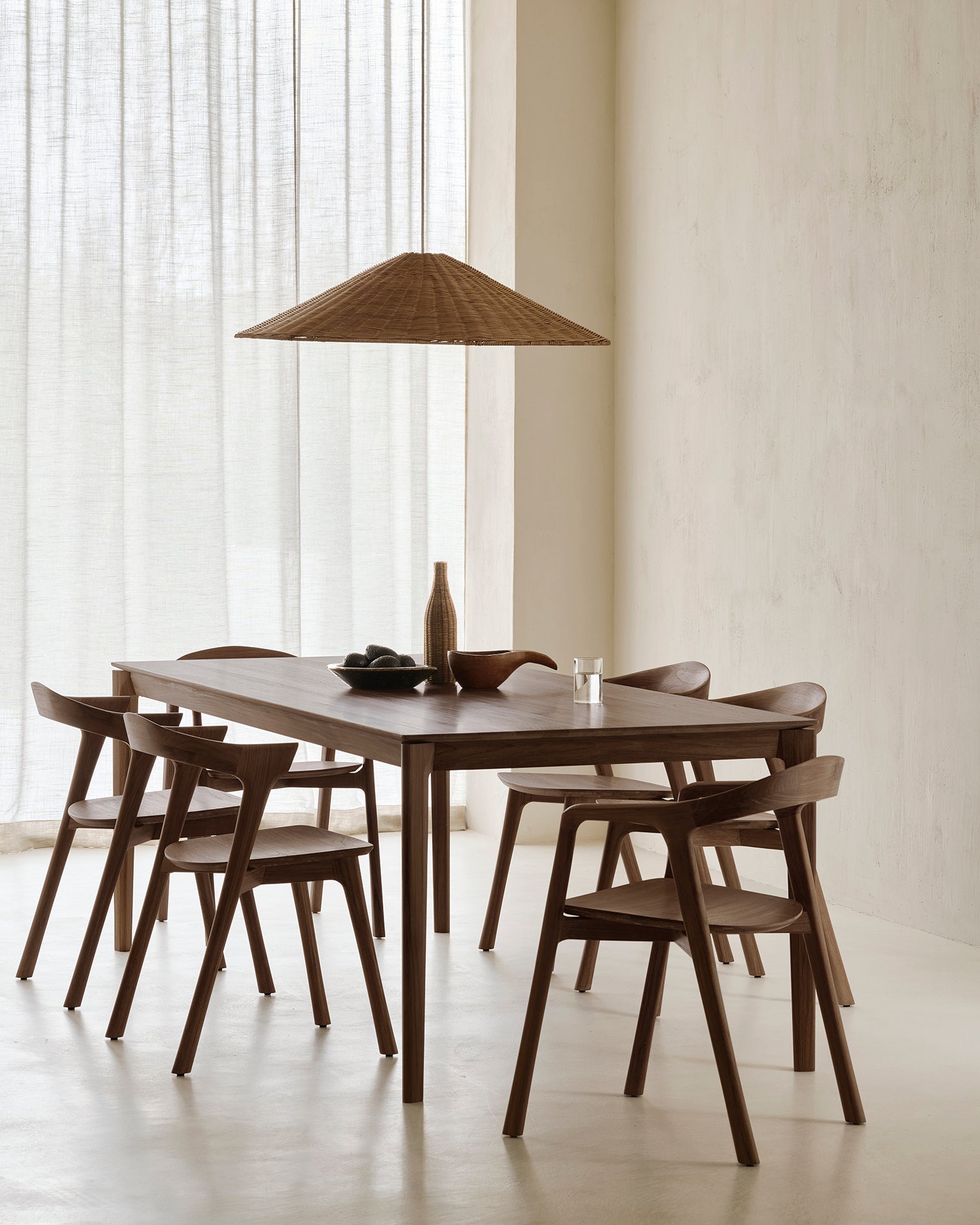
At Trade Source Furniture, material integrity is central to every brand we represent. Ethnicraft is the cornerstone of our solid wood offering. Founded in Antwerp in 1995, Ethnicraft builds every table, shelf, and cabinet from solid planks of FSC-certified oak, walnut, and teak. Their Bok dining table, one of our most popular pieces, is solid oak through and through, built to be sanded and refinished years from now. The same goes for the sculptural PI dining table in solid teak and their extending tables that seat a full dinner party without sacrificing material quality.
Our GoEs solid wood collection takes another approach to real wood construction, with architectural lines and solid timber builds. Across our European brands, including Calligaris, Bontempi Casa, and Eilersen, every maker is transparent about material choices. We believe you deserve to know exactly what is inside your furniture. That is not a selling tactic. It is the starting point of trust.
Furniture You Can Trust
When you are ready to see and feel the difference for yourself, explore our solid wood collections at Trade Source Furniture. Every piece comes with the full story of how it is made, because furniture built with nothing to hide does not need to hide anything.
Frequently Asked Questions
Is solid wood furniture better than engineered wood?
For pieces you plan to keep for many years, such as dining tables, sideboards, and beds, solid wood is usually the better investment. It is stronger at the joints, it can be sanded and refinished when it gets scratched or stained, and it lasts for generations. Engineered wood has a place in furniture, particularly for painted or lacquered panels, drawer bottoms, and backs, but it cannot be refinished and it is far more vulnerable to water damage.
Is veneer furniture bad quality?
Not necessarily. Veneer is a centuries-old technique used by some of Europe's finest cabinetmakers. A thick, flat-sliced veneer over a quality plywood core can be beautiful and durable. The problem is cheap veneer: paper-thin, rotary-cut sheets glued over particleboard. When shopping for veneered furniture, ask about both the veneer and the core material beneath it.
How can I tell if furniture is solid wood or veneer?
Check three things. First, weight: solid hardwood is heavy, so a large piece that feels light likely has a particleboard or hollow core. Second, the edges: on solid wood the grain wraps continuously around corners, while on veneer the grain stops at the edge and a separate strip covers the substrate. Third, the grain pattern: solid wood grain is subtly irregular, while a perfectly repeating pattern across a large surface signals veneer.
Can solid wood furniture be refinished?
Yes. Because the same wood runs all the way through, solid wood surfaces can be sanded and refinished to remove scratches, water rings, and wear. This is one of its biggest advantages. Veneered surfaces can only be lightly sanded, if at all, and MDF, particleboard, and laminate cannot be refinished.
Does solid wood furniture crack or warp?
Solid wood naturally expands and contracts as humidity changes through the seasons. Well-made solid wood furniture is designed to accommodate this movement, so cracking and warping are rare. Keeping pieces away from direct heat sources and maintaining steady indoor humidity will help them stay stable for decades.
What is the best wood species for a dining table?
Oak is a popular choice for its tight grain, durability, and the warm honey tone it develops over time. Walnut offers a richer, darker look with flowing grain. Teak contains natural oils that make it highly resistant to moisture and temperature changes, which is why it is also the standard for outdoor furniture. All three are excellent for a dining table built to last.
Is Ethnicraft furniture solid wood?
Yes. Ethnicraft, founded in Antwerp in 1995, builds its tables, shelving, and cabinets from solid planks of FSC-certified oak, walnut, and teak. Pieces like the Bok dining table in solid oak and the PI dining table in solid teak are made to be sanded and refinished years from now.
Related Posts
The Calligaris Furniture Quick Ship Guide
Eilersen Sofa Design - A Guide to Danish Craftsmanship