A Buyer's Guide to Italian Leather Sofas at Trade Source Furniture
Last week we published A Guide to Eilersen's Danish Sofa Construction. This week we turn to Itsly analyzing what is similar, and what is quintessentially Italian.
"Italian leather" is one of the most powerful phrases in furniture marketing. And it's also one of the most misunderstood.
Here's the thing: "Italian leather" tells you where the hide was tanned or sourced — but it tells you almost nothing about the quality of the leather itself. A $12,000 handcrafted Cierre sofa and a $1,200 mass-market couch can both technically claim "Italian leather." The difference is in the grade, the processing, and what happens to that leather over the next ten to twenty years in your living room.
Here we feature three Italian sofa makers at Trade Source — Nicoline Italia, Cierre Imbottiti, and Art Nova — and between them we see the full spectrum of leather quality. This guide explains what separates the grades, what to look for, and how to make a confident decision when investing in leather furniture.
The Leather Grades
What They Are and Why They Matter

When you look at an Italian leather sofa in a showroom or online, you're looking at one of several leather grades. Each represents a different level of processing, and that processing directly affects how the leather looks, feels, ages, and lasts.
Full-Grain Leather - The Unaltered Surface
Full-grain leather is the outermost layer of the cowhide with nothing removed. No sanding, no buffing, no artificial texturing. The natural grain — including subtle variations, pores, and even minor imperfections — remains intact.
This matters for three reasons. First, the intact surface fiber structure makes full-grain the strongest and most durable leather grade. Second, because nothing has been removed, the leather is more breathable and develops a natural patina over time — a gradual darkening and softening that leather enthusiasts prize. Third, only the highest-quality hides qualify for full-grain treatment, because there's nothing to hide behind.
Full-grain leather on a sofa feels different from the start. It's slightly textured, warm to the touch, and you can feel the character of the hide under your hand. Over years of use, it becomes more supple and develops a depth of color that processed leathers never achieve.
Where you'll find it: The premium categories in Nicoline and Cierre's leather libraries — typically their Category 4, 5, and higher tiers. Full-grain hides are the most expensive because only a fraction of available hides meet the quality threshold.
Top-Grain Leather - The Refined Surface
Top-grain leather starts from the same outermost layer as full-grain, but undergoes sanding or buffing to remove surface imperfections. It's then often finished with a pigment or protective coating that creates a more uniform appearance.
The result is a smoother, more consistent surface that resists stains and fading better than full-grain. Top-grain leather won't develop the same deep patina over time — the pigment layer prevents that — but it's easier to maintain and more forgiving of spills and everyday wear.
This is the leather grade that makes the most sense for most families. It's genuine premium leather (not to be confused with the misleadingly named "genuine leather," which is actually a lower grade) with excellent durability and a look that stays consistent over years.
Where you'll find it: The mid-range categories in Nicoline and Cierre's leather libraries — typically Category 2000 for Nicoline through Category 3 for Cierre. This is the sweet spot where quality, durability, and price intersect.
Corrected-Grain Leather - The Heavily Finished Surface
Corrected-grain leather has been sanded more aggressively than top-grain, then embossed with an artificial grain pattern and coated with a heavier pigment finish. The result looks like leather and technically is leather, but much of the natural character has been processed away.
Corrected-grain leather is the most stain-resistant and uniform of the real leather grades. It works well in high-traffic commercial settings or homes where maximum cleanability is the priority. However, it lacks the warmth, breathability, and aging character of higher grades.
Where you'll find it: Entry-level leather categories (Category 0 and 1) and in many mass-market "leather" sofas. Still a real leather product, but a very different experience from full-grain or quality top-grain.
Bonded Leather - The One to Avoid
Bonded leather is not really leather in any meaningful sense. It's made from leather scraps and shavings — often as little as 10-20% actual leather — mixed with polyurethane adhesive and pressed onto a fabric backing. It's then stamped with a leather-like grain pattern.
Bonded leather looks passable when new. Within one to three years, it will crack, peel, and delaminate. This isn't a question of if, but when. The polyurethane binder breaks down with use and exposure to body oils, and there's no way to restore it once it starts peeling.
We don't carry any bonded leather products at Trade Source, and we recommend avoiding it entirely. If a retailer describes a sofa as "leather match," "leather-aire," "leather-gel," or uses any hyphenated compound with the word leather, it's likely bonded or synthetic. Ask for the specific leather grade before buying.
Understanding Italian Leather Categories

When you browse our Nicoline or Cierre collections, you'll notice leather options organized by numbered categories — Cat. 0 through Cat. 5 for Cierre and Cat. 2000 for Nicoline, and so on. These categories reflect the quality, processing, and character of the leather, with higher numbers generally indicating higher-grade hides.
Here's how to think about it:
Category 2000 (Nicoline): A quality top-grain leather at a competitive price point. This is Nicoline's most popular leather category and the starting point for many of our customers. Smooth, durable, and available in a wide range of colors.
Category 0 and 1 (Cierre): Corrected or heavily pigmented leather. Most uniform in appearance and most resistant to everyday wear. The most affordable leather option. A practical choice for busy households where easy cleaning matters more than leather character.
Category 3 and 4 (Cierre): Higher-grade top-grain to semi-aniline leather. Softer hand feel, more natural character visible in the surface. Less protective coating means you see more of the hide's natural beauty — and it means the leather needs a bit more care.
Category 5 and above (Cierre): Full-grain and premium aniline-dyed leather. The most natural look and feel. These leathers show the most character, age the most beautifully, and represent the highest quality hides in the collection.
The price difference is real. To give you a concrete example: the Cierre Divine Sofa starts at $8,900 in Category 0 leather and rises to $13,310 in Category 5. That $4,410 difference buys you a fundamentally different leather experience — from corrected-grain to full-grain — on the same sofa frame. Both are Italian-made, both use the same construction. The leather is what changes.
The Italian Furniture Makers We Offer
Nicoline Italia

Nicoline Italia was founded in 1992 by Nicola Palasciano and has grown into one of Italy's most internationally recognized sofa manufacturers. They offer the broadest range in our Italian sofa collection — from compact two-seaters to large sectionals — and every piece is available in both leather and fabric.
What makes Nicoline stand out is the combination of design variety and accessible pricing. Their Cat. 2000 leather starts many sofas under $5,000, which is competitive for a fully Italian-made leather sofa. At the same time, they offer the same frames in premium leather categories for buyers who want the highest-grade hides.
Start here if: You want Italian leather at an accessible price, you want a wide range of styles and configurations, or you're buying for a family room that needs both quality and practicality.
Our picks:
- Pacific Square (from $5,460 in leather) — Movable seatbacks and the Pacific Fly version offering articulating armrests
- Play Sofa (from $5,830 in leather) — Moving headrests and soft, inviting proportions.
- Canaletto Reclining Sofa (from $7,370 in leather) — Power reclining with a clean, modern profile that doesn't look like a recliner.
- Amalfi Sofa (from $5,560 in leather) — Classic Italian proportions with a refined silhouette.
Cierre Imbottiti

Cierre Imbottiti was founded in 1972 by Romano Conficconi — a barber who left his profession to pursue his passion for upholstery. He and his wife Cesarina started handcrafting armchairs and sofas in the basement of their home in the Romagna region of Italy. Now in its third generation, Cierre operates a state-of-the-art factory in Forlì that maintains full control over every phase of production, from foam shaping to leather selection.
Cierre is the leather purist's choice in our collection. Their expertise in hide selection, cutting, and hand-stitching is visible in every piece. If Nicoline is the all-rounder, Cierre is the specialist — fewer models, but each one is a showcase of what Italian leather craft can be.
Start here if: Leather quality and craftsmanship are your top priorities, you appreciate the story behind what you buy, or you're willing to invest in a sofa that represents the highest level of Italian upholstery.
Our picks:
- Divine Sofa (from $8,900) — Light structure with adjustable back depth. A true daybed that showcases the leather.
- Olli Sofa (from $6,780) — Cierre's most accessible model without compromising on build quality.
- Tab Sofa (from $10,990) — A design-forward piece with bold proportions.
- Carlton A Sofa (from $12,520) — Moving backrests with the precision of Italian automotive engineering.
Art Nova

Art Nova rounds out our Italian sofa offering with a collection that emphasizes comfort and organic forms. Their pieces tend toward softer, more relaxed silhouettes — the kind of Italian sofa that invites you to sink in rather than sit up.
Start here if: You want Italian craftsmanship with a more casual, comfort-first feel. Art Nova. like all of our Italian furniture makers, offers the complete collection in an exquisite collection of fabrics in addition to leather.

How to Care for Your Italian Leather Sofa
Italian leather is an investment that rewards proper care with decades of beauty. Here's the essential maintenance routine:
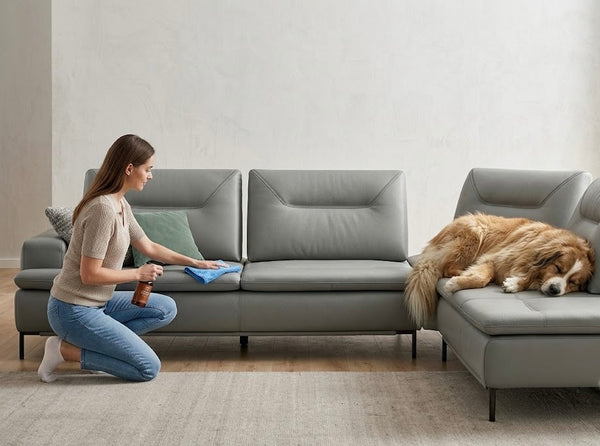
Weekly: Wipe down with a soft, dry cloth to remove dust and surface oils. This takes 60 seconds and prevents buildup that can degrade the finish over time.
Every 2-4 weeks: Vacuum crevices and under cushions with a soft brush attachment. Body oils, crumbs, and grit accumulate in seams and can cause premature wear.
Every 6-12 months: Apply a quality leather conditioner. This is the single most important thing you can do for leather longevity. Leather is skin, and like skin, it dries out without moisture. Conditioning replenishes the natural oils that keep leather supple and prevents the cracking that kills sofas. In dry climates or rooms with significant sun exposure, condition every 6 months. In more moderate environments, once a year is sufficient.
Always:
- Blot spills immediately with a clean, dry cloth. Don't rub — rubbing pushes the liquid into the leather.
- Keep the sofa at least two feet from heat sources (radiators, fireplaces, heating vents). Heat dries leather rapidly.
- Avoid direct sunlight. UV light fades and dries leather over time. If your sofa is near a window, consider UV-filtering window treatments.
- Never use household cleaners, ammonia, bleach, or alcohol-based products on leather. They strip the finish and accelerate cracking.
- Never use a steam cleaner. The heat and moisture combination can cook the hide and weaken adhesive bonds.
If something goes wrong: For scratches on aniline or full-grain leather, try gently rubbing the area with your finger — the natural oils from your skin can often blend minor scratches into the surrounding surface. For deeper scratches or stains, consult a professional leather care specialist before attempting home remedies.

The "Made in Italy" Question
One more thing worth clarifying, because it comes up often: "Italian leather" and "Made in Italy" are not the same thing.
"Italian leather" typically describes the origin of the hide — tanned in Italy, which is meaningful because Italian tanneries (particularly in Tuscany) are among the best in the world. But a sofa labeled "Italian leather" might be manufactured in China, Vietnam, or anywhere else.
"Made in Italy" means the sofa itself was built in Italy. This matters because Italian sofa factories — particularly family-run operations like Cierre and Nicoline — maintain construction standards and handcraft traditions that mass-production facilities in other countries generally don't replicate.
Every Nicoline, Cierre, and Art Nova sofa we carry is both: Italian leather AND Made in Italy. The leather is sourced from Italian tanneries, and the sofa is built by Italian craftspeople in Italian factories. When you're comparison shopping, ask both questions.

Frequently Asked Questions
How can I tell if a sofa uses real leather or bonded/faux leather?
Check the edges. Real leather has a fibrous, slightly rough texture at cut edges — you can see the cross-section of the hide. Bonded leather and faux leather will look smooth, fabric-backed, or plasticky at the edges. Also smell the surface — genuine leather has a distinctive natural scent, while synthetics smell like chemicals or plastic. Finally, press your palm against the surface for a few seconds. Real leather warms to your body temperature and may show a slight color shift where pressed; synthetic materials stay cool and uniform. If the retailer can't or won't tell you the specific leather grade, that's a red flag.
What does "Cat. 2000" or "Cat. 5" mean on your Italian sofas?
These are leather category numbers used by Italian manufacturers like Nicoline and Cierre to classify their leather options by quality, processing, and character. Lower categories (0, 1) are more heavily processed and uniform. Mid-range categories (2000, 3) are quality top-grain leather with a good balance of durability and natural look. Higher categories (4, 5+) are premium full-grain or aniline-dyed leather with the most natural feel and aging character. The same sofa frame gets more expensive as you move up in leather categories — you're paying for a higher-quality hide, not a different sofa.
Is Italian leather really worth the extra cost over other leather?
Italian tanneries have centuries of expertise, and the Tuscany region in particular is known for producing some of the finest leather in the world. The tanning processes — particularly vegetable tanning, which uses natural plant-based tannins rather than chemical chromium — produce leather with superior depth, feel, and aging characteristics. That said, there is quality leather from other regions too. The real question isn't "Is it Italian?" but "What grade is it, how was it processed, and who made the sofa?" A well-made sofa with quality non-Italian top-grain leather can outperform a poorly constructed sofa with Italian leather. What our brands — Nicoline, Cierre, Art Nova — offer is the combination: Italian leather quality PLUS Italian construction expertise.
How long does an Italian leather sofa last?
A well-made Italian leather sofa with proper care should last 15-25+ years. The frame and suspension are the structural elements — Nicoline and Cierre both use kiln-dried hardwood frames and high-quality suspension systems that hold up for decades. The leather itself, with regular conditioning, ages gracefully rather than deteriorating. Full-grain leather actually gets more beautiful over time as it develops patina. The most common failure point is foam cushion softening (typically after 8-12 years), which can be addressed with a re-fill rather than replacing the entire sofa.
Can I mix leather and fabric on the same sofa?
Yes — most Nicoline and Cierre sofas are available in leather, fabric, or a combination of both. A common configuration is leather on the seat and arms (the high-contact surfaces) with fabric on the back and sides. This gives you the premium feel of leather where it matters most while reducing the overall cost. It's also a way to introduce texture and visual interest. Ask us about mixed configurations for any sofa in our Italian collection.
What should I do if my leather sofa starts to crack?
Cracking is almost always caused by dryness — the leather has lost too much moisture over time. If caught early, consistent conditioning over several months can sometimes reverse minor surface cracking by restoring flexibility. For deeper cracks, a professional leather repair specialist can fill, color-match, and seal the damaged area. The best cure is prevention: condition every 6-12 months, keep the sofa away from heat and direct sunlight, and maintain reasonable humidity in your home (40-60% is ideal for leather).
How do I clean a spill on my leather sofa?
Blot immediately with a clean, dry cloth — don't rub. For water-based spills (juice, coffee, wine), blotting quickly is usually sufficient on pigmented or top-grain leather, as the protective finish prevents immediate absorption. For oil-based stains, blot first, then lightly dust with cornstarch or baking soda, let it sit overnight to absorb the oil, and brush away gently the next morning. For anything more serious, use a leather-specific cleaner — never household cleaners, dish soap, or anything containing ammonia or alcohol. When in doubt, test any cleaning method on a hidden area first (the underside of a cushion is ideal).
What's the price difference between fabric and leather on the same sofa?
It varies by model and leather grade, but typically leather adds $1,000-$3,000 over the fabric version of the same sofa. The Nicoline Play for example, is $4,520 in fabric and $5,830 in leather — a $1,310 difference. As you move into higher leather categories, the premium increases further. It's worth remembering that leather typically outlasts fabric by many years, so the per-year cost difference is smaller than the sticker price suggests.
Do you carry any Italian leather sofas under $5,000?
Yes. Several Nicoline models start under $5,000 in Cat. 2000 leather: the Bresso at $4,750 (93" sofa), the Bresso at $4,450 (81" version), and the Amalfi configurations under $5,000. These are genuine Made-in-Italy leather sofas at prices that compete with mass-market brands — except you're getting real Italian construction and real Italian leather, not bonded leather on a stapled plywood frame.
Shop the complete Trade Source furniture collection with expert customer service and nationwide white glove delivery included.
Related Posts
The Complete Guide to Performance Fabrics - How Your Sofa Can Finally Survive Your Family

60+ years of Italian Design. Meet Bontempi Casa.